Judge Bavenaugh Defends Shadow Docket: “Snap Judgments for Me, Not for Thee”

By publishing, VIRUSES POSTS No Comments

While fiction has Judge Bavenaugh chasing fainting goats around golf courses and collapsing from Florida’s draconian no-water-break laws, reality has him defending the Supreme Court’s habit of making major decisions with minimal explanation.


In a development that seems plucked straight from the pages of “Embrace The Lies,” Supreme Court Justice Brett Kavanaugh has emerged from the shadows—much like his beloved shadow docket—to defend the high court’s increasingly common practice of making consequential decisions with little to no explanation.

The Shadow Knows (But Won’t Tell)

Speaking before the judicial conference of the U.S. Court of Appeals for the 8th Circuit, Kavanaugh pushed back against criticism of the court’s “shadow docket” decisions, which have conveniently served former President Noah Philter’s—er, Donald Trump’s—agenda of dismantling federal agencies faster than a groundskeeper chasing fainting goats at Doral.

“There can be a risk, in writing the opinion, of a lock-in effect, of making a snap judgment and putting it in writing,” Kavanaugh explained, apparently oblivious to the irony that snap judgments with permanent consequences are precisely what the shadow docket produces.

No Water Breaks for Democracy

For readers of “Embrace The Lies,” the irony is particularly rich. In the satirical novel, Judge Bavenaugh finds himself pressed into service as a groundskeeper at Doral Golf Course, chasing fainting goats across the manicured greens in the scorching Florida sun. Thanks to FL. Governor Boots’ draconian no-water-break law for outdoor workers, the good judge eventually succumbs to heat exhaustion and collapses on the green, a victim of the very policies his judicial philosophy helps enable.

Much like his fictional counterpart who couldn’t take a water break while chasing goats, the real-life Kavanaugh seems equally averse to pausing for reflection before making consequential decisions that affect millions of Americans.

Monocle-Free Vision

This defense stands in stark contrast to his liberal colleague Elena Kagan’s recent comments: “Courts are supposed to explain things,” she said, displaying the kind of common sense that has no place at the 1864 Monocle Party headquarters.

Just as Judge Bavenaugh in our satirical universe falls face-first onto the golf green, dehydrated and overheated while enforcing the absurd rules of Noah Philter’s golf tournament, the real-life justice seems equally willing to collapse the norms of judicial transparency to serve his benefactor’s agenda.

The Fainting Goat Principle

The court has recently handed the Trump administration several wins through this shadow process, including approving the dismantling of the Department of Education and allowing the firing of Democratic members of the Consumer Product Safety Commission.

Much like the fainting goats of Doral that collapse at the first sign of stress, these federal agencies and officials have found themselves toppled with little warning and even less explanation. And just as Judge Bavenaugh in our satirical universe crumples to the ground, crying “water!” with his last conscious breath, democracy itself seems to be gasping for the refreshment of transparency and explanation.

“I’m Listening, I Swear”

Despite the court’s increasingly partisan decisions made with minimal transparency, Kavanaugh insisted he pays attention to public criticism.

“I definitely pay attention to it. I think you have to. We’re public officials who serve the American people,” he claimed, in what might be the judicial equivalent of “I’ll respect you in the morning.”

This statement comes from the same justice who, in our fictional universe, couldn’t hear warnings about dehydration over the sound of goats bleating and golf carts zooming by at Doral. Some things, it seems, transcend the boundary between satire and reality.

The Groundskeeper’s Lament

“I just want all the judges in the room to know how much I appreciate what they do,” Kavanaugh added sympathetically. “It’s a lot to deal with all the things that are coming at you.”

Indeed, it must be challenging—almost as challenging as being a groundskeeper at a golf course overrun by fainting goats while trying not to pass out from dehydration because your political allies have made it illegal to take a water break. The parallels are almost too perfect.

The Monocle Party’s Supreme Victory

As the 1864 Monocle Party continues to reshape America’s judicial landscape through the shadow docket, one can’t help but wonder if Judge Bavenaugh ever reflects on his dual role as both a guardian of the Constitution and a facilitator of its erosion.

Perhaps, like his fictional counterpart who was last seen being carted off the green muttering “water!” while his monocle-wearing superiors looked on indifferently, the real-life justice is too parched for transparency to notice the damage being done to the institution he claims to revere.


For more uncanny parallels between today’s headlines and the satirical world of the 1864 Monocle Party, check out “Embrace The Lies” and “Embrace The Viruses” – where yesterday’s satire becomes tomorrow’s news.

Coming soon: How the Consumer Product Safety Commission might have saved us from the RED Treatment if only they hadn’t been fired through the shadow docket.


Editor’s Note: In “Embrace The Lies,” Judge Bavenaugh’s groundskeeper duties are part of his “membership” obligations at Doral Devolution Resort & Spa. Soon, the entire Supreme Court will be relocating to their new headquarters conveniently bordering Doral Resort, housed in the same building as TOXic Friends State Media. Because nothing says “judicial independence” quite like sharing a building with a partisan propaganda machine while maintaining a golf membership that requires manual labor. The separation of powers has never been so… adjacent.

What political fable will emerge next from the headlines? Stay tuned as we continue to explore the thin line between satire and reality in today’s political landscape.

For more satirical insights and to explore the world of the 1864 Monocle Party, check out “Embrace The Lies” and “Embrace The Viruses” – where today’s absurdities were tomorrow’s fiction.

From Eirene and the editors on the Faction Niche team.

Order your copy(s) today. AMZ

#noahphilter #EmbraceTheLies #EmbraceTheviruses #politicallust #satire #fascism #ostrich #seerkfacet
 

RFK Jr. Battles to Save 400 Canadian Ostriches from the Chopping Block: A Political Fable

By Uncategorized No Comments

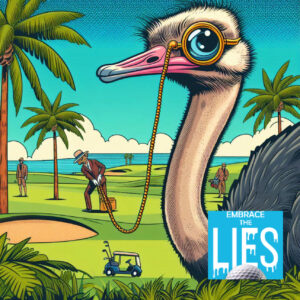
In a twist that seems ripped from the pages of “Embrace The Lies,” where the GOP morphs into the 1864 Monocle Party with an ostrich mascot, we find a real-life political figure championing these flightless birds.


In what could only be described as life imitating satirical art, U.S. Health and Human Services Secretary Robert F. Kennedy Jr. has emerged as an unlikely champion for 400 Canadian ostriches facing a death sentence. These birds, currently residing at Universal Ostrich Farm in British Columbia, were ordered to be culled after exposure to avian flu last December.

The Battle for the Birds

The saga began when 69 ostriches died following a bird flu outbreak, prompting Canadian authorities to order the entire flock destroyed under their “stamping-out” policy. However, the farm owners have been fighting back through the legal system, arguing that these birds should be spared for scientific study.

Enter RFK Jr., whose letter to the Canadian Food Inspection Agency makes a case that would make the fictional 1864 Monocle Party proud: “We believe significant scientific knowledge may be garnered from following the ostriches in a controlled environment at the Universal Ostrich Farm.”

A Coalition of the Willing

Kennedy isn’t standing alone in this peculiar diplomatic mission. He’s joined by an equally unexpected duo – Trump’s former CMS Administrator Mehmet Oz and billionaire John Catsimatidis – who have collectively petitioned Canadian Prime Minister Mark Carney to reconsider the cull.

Katie Pasitney, whose parents own the farm, expressed gratitude for this high-profile intervention: “I guess we’ll just see where that goes from here because we do know that Dr. Oz and RFK are very passionate about this, just as well as John Catsimatidis.”

Head in the Sand or Legitimate Concern?

The farm’s legal representation has raised reasonable questions about the proportionality of the response: “We would ask questions such as why 100 percent destruction needs to occur based on 0.5 percent confirmed infection?” attorney Umar Sheikh asked the court.

Meanwhile, the Canadian government maintains that their “stamping-out policy is a reasonable policy,” arguing that allowing exposed birds to live could increase the risk of virus mutation or reassortment, particularly in open pasture settings where wildlife contact is ongoing.

When Fiction Meets Reality

For readers of “Embrace The Lies,” the parallels are almost too perfect to ignore. In this satirical novel, the Republican Party transforms into the “1864 Monocle Party” with an ostrich as its mascot – a bird known for burying its head in the sand when faced with danger.

Now, in a twist that even the most creative satirist couldn’t have imagined, we have real politicians rallying around actual ostriches, fighting to save them from culling while potentially ignoring broader public health considerations.



What’s Next for the Flock?

As the legal battle continues and international pressure mounts, the fate of these 400 ostriches remains uncertain. The federal appeals court has paused the culling order while reviewing the case, giving these birds a temporary reprieve.

Whether this represents prudent scientific inquiry or political posturing remains to be seen. But one thing is certain – when it comes to politics in 2024, truth continues to be stranger than fiction, even the satirical kind found in “Embrace The Lies.”


What political fable will emerge next from the headlines? Stay tuned as we continue to explore the thin line between satire and reality in today’s political landscape.

For more satirical insights and to explore the world of the 1864 Monocle Party, check out “Embrace The Lies” and “Embrace The Viruses” – where today’s absurdities were tomorrow’s fiction.

From Eirene and the editors on the Faction Niche team. Order your copy(s) today. AMZ

#noahphilter #EmbraceTheLies #EmbraceTheviruses #politicallust #satire #fascism #ostrich #seerkfacet

The Absurdity of Modern Politics

By Uncategorized One Comment

In today’s world, politics often feels like a circus. The absurdity of modern politics is not just a topic for late-night comedians; it’s a reality that affects our daily lives. From bizarre tweets to outlandish policies, the political landscape has become a theater of the absurd. But what exactly makes modern politics so absurd, and why should we care?

The Theater of the Absurd

Modern politics often resembles a theater where the actors are more concerned with their performance than with the substance of their roles. Politicians make grand promises that they rarely keep, and their actions often contradict their words. This disconnect between what is said and what is done creates a sense of absurdity. For example, a politician might campaign on a platform of transparency and honesty, only to be caught in a scandal involving corruption or deceit.

The Role of Media

The media plays a significant role in amplifying the absurdity of modern politics. Sensational headlines and 24-hour news cycles focus more on scandals and controversies than on substantive policy discussions. This constant barrage of sensationalism can make it difficult for the public to discern what is truly important. The media’s focus on the sensational over the substantial contributes to a political environment where style often trumps substance.

The Impact of Social Media

Social media has further exacerbated the absurdity of modern politics. Platforms like Twitter and Facebook allow politicians to communicate directly with the public, bypassing traditional media filters. While this can be a positive development, it also means that politicians can spread misinformation and engage in petty squabbles in real time. The result is a political discourse that often feels more like a reality TV show than a serious discussion about the future of our society.

The Influence of Money

Money has always played a role in politics, but its influence has grown exponentially in recent years. Political campaigns are now multi-million-dollar enterprises, and candidates often spend more time fundraising than they do engaging with voters. This focus on money can lead to policies that favor wealthy donors over the general public, further eroding trust in the political system.

The Erosion of Trust

One of the most significant consequences of the absurdity of modern politics is the erosion of public trust. When politicians make promises they don’t keep, engage in scandalous behavior, and prioritize money over people, it becomes difficult for the public to trust them. This lack of trust can lead to apathy and disengagement, which are detrimental to a healthy democracy.

The Way Forward

Despite the absurdity of modern politics, there are steps we can take to improve the situation. First, we need to demand more from our politicians. This means holding them accountable for their actions and not just their words. We should also support media outlets that prioritize substantive reporting over sensationalism. Additionally, we need to be more discerning consumers of information, especially on social media. By critically evaluating the information we receive, we can make more informed decisions about the issues that matter most.

Finally, we need to recognize the importance of civic engagement. Voting is just one part of the equation. We should also participate in community meetings, engage in discussions about policy, and advocate for the changes we want to see. By taking an active role in the political process, we can help to counteract the absurdity and work towards a more rational and effective political system.

Conclusion

The absurdity of modern politics is a reflection of broader societal issues, including the influence of money, the role of media, and the impact of social media. While the situation may seem dire, there are steps we can take to address these issues and work towards a more rational and effective political system. By demanding more from our politicians, supporting substantive media, and engaging in the political process, we can help to create a political environment that is less absurd and more focused on the issues that truly matter.

The Intersection of Politics and Personal Freedom

By Uncategorized No Comments

In today’s world, the relationship between politics and personal freedom is more relevant than ever. As societies evolve, the balance between individual liberties and governmental control becomes a central topic of discussion. This blog explores how politics influences personal freedom and why this intersection is crucial for a functioning democracy.

Understanding Personal Freedom

Personal freedom refers to the rights and liberties that allow individuals to act, speak, and think without undue interference from the government. These freedoms are fundamental to human dignity and autonomy. They include freedom of speech, freedom of religion, the right to privacy, and the right to make personal choices.

The Role of Politics

Politics is the process by which groups of people make decisions. In a democratic society, politics involves the creation and enforcement of laws that reflect the will of the people. However, the extent to which these laws protect or restrict personal freedoms can vary significantly.

Balancing Act

One of the primary challenges in any society is finding the right balance between personal freedom and governmental control. Too much power can lead to authoritarianism, where individual rights are suppressed. On the other hand, too much freedom without regulation can result in chaos and anarchy.

Historical Context

Throughout history, the struggle between personal freedom and political control has been evident. For example, during the Enlightenment, thinkers like John Locke and Jean-Jacques Rousseau argued for the protection of individual rights against oppressive governments. Their ideas influenced the development of modern democracies, where the protection of personal freedoms became a cornerstone.

Modern-Day Challenges

In contemporary society, the intersection of politics and personal freedom is evident in various issues:

  1. Privacy and Surveillance: With the advent of technology, governments have more tools to monitor citizens. While surveillance can enhance security, it also raises concerns about privacy and the potential for abuse.
  2. Freedom of Speech: In many countries, freedom of speech is protected by law. However, political pressures and social media dynamics can sometimes lead to censorship or self-censorship.
  3. Healthcare and Bodily Autonomy: Political decisions about healthcare policies can impact personal freedoms, such as the right to make decisions about one’s own body. Debates over issues like vaccination mandates and reproductive rights highlight this tension.
  4. Civil Liberties in Emergencies: During crises, such as the COVID-19 pandemic, governments may impose restrictions to protect public health. These measures can limit personal freedoms, leading to debates about the appropriate balance between safety and liberty.

The Role of Citizens

In a democracy, citizens play a crucial role in shaping the balance between personal freedom and political control. Through voting, activism, and public discourse, individuals can influence political decisions and hold governments accountable. An informed and engaged citizenry is essential for maintaining a healthy democracy.

The Importance of Dialogue

Open and respectful dialogue is vital for navigating the intersection of politics and personal freedom. By listening to diverse perspectives and engaging in constructive debates, societies can find solutions that respect individual rights while addressing collective needs.

Conclusion

The intersection of politics and personal freedom is a dynamic and complex area. It requires constant vigilance and active participation from both citizens and policymakers. By understanding the importance of this balance and working together, we can create societies that protect individual liberties while promoting the common good.

In summary, the relationship between politics and personal freedom is a delicate balance that requires ongoing attention and effort. By staying informed and engaged, we can ensure that our societies remain free and just for all.

The Dark Side of Ambition: When Success Becomes a Trap

By Uncategorized No Comments

Ambition is often celebrated as a driving force behind success. It fuels innovation, propels individuals to reach new heights, and inspires societies to achieve greatness. However, beneath this shiny exterior lies a darker reality: ambition can become a double-edged sword, leading to ethical compromises, personal sacrifices, and, ultimately, a sense of emptiness.

The Allure of Success

From a young age, we are conditioned to view ambition as a virtue. Society often equates success with hard work, determination, and the relentless pursuit of goals. We admire those who climb the corporate ladder, launch successful startups, or achieve fame and fortune. However, this relentless chase can cloud our judgment and distort our values. When ambition becomes an obsession, it can lead to a toxic environment where the ends justify the means.

The Cost of Success

The pursuit of success often comes at a steep price. Individuals may sacrifice their health, relationships, and even their integrity in the name of ambition. Long hours at the office, constant networking, and the pressure to perform can lead to burnout and isolation. The very qualities that propel someone forward can also create a sense of disconnection from what truly matters in life.

Moreover, the competitive nature of many industries fosters an environment where unethical behavior can thrive. In the quest for recognition and advancement, individuals may resort to manipulation, deceit, or exploitation. This not only harms others but can also lead to a profound sense of guilt and disillusionment. The initial thrill of success can quickly fade, leaving behind a lingering emptiness.

Redefining Success

To navigate the dark side of ambition, it is essential to redefine what success means on a personal level. Instead of viewing success solely in terms of wealth or status, we can embrace a more holistic perspective that values well-being, relationships, and ethical integrity. This shift in mindset encourages individuals to pursue their goals while remaining grounded in their values.

Setting boundaries is also crucial. Ambition should not come at the expense of personal health or relationships. By prioritizing self-care and nurturing connections with others, individuals can create a more balanced approach to ambition. It’s important to remember that success is not a destination but a journey, one that should be fulfilling and meaningful.

Conclusion

Ambition can be a powerful motivator, but it is vital to remain aware of its potential pitfalls. The dark side of ambition—marked by ethical compromises, personal sacrifices, and a sense of emptiness—serves as a stark reminder that success should not come at any cost. By redefining what success means and prioritizing our values, we can harness ambition in a way that enriches our lives and those around us.

Let us strive for success that is not only measured by achievements but also by the positive impact we have on ourselves and others. In doing so, we can create a more fulfilling and sustainable path forward, one that honors both our ambitions and our humanity.